
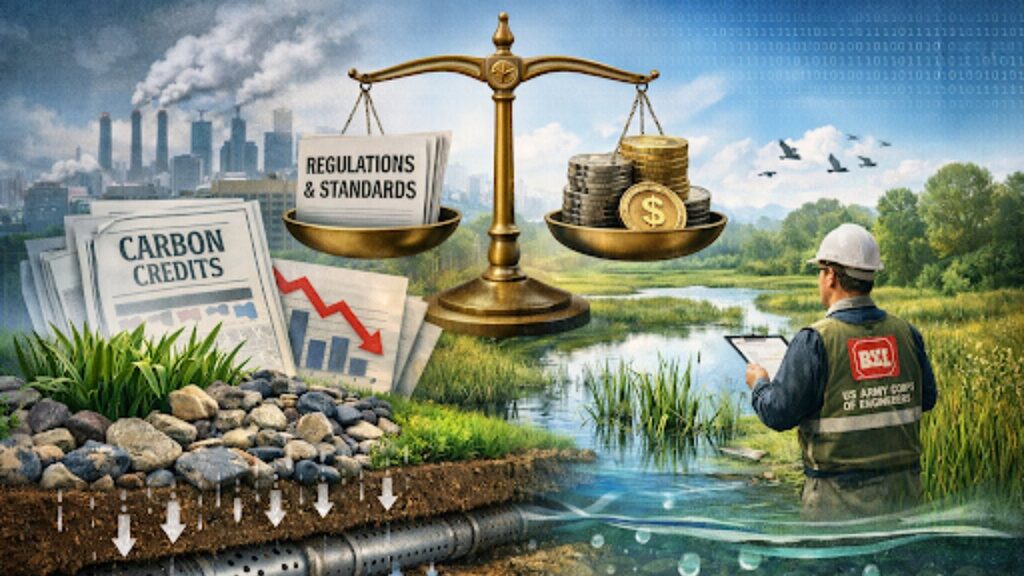
Stormwater is no longer viewed only as a compliance obligation. As measurable outcomes begin to carry financial value, performance must be trusted, verified, and protected. In Part 5 of their series, Davis Allen explores what other outcome based environmental markets reveal about trust, rulemaking, and long term stability.
The central question is simple. When environmental performance becomes monetized, who defines the rules, and when?
Lessons from the Voluntary Carbon Market
Voluntary carbon markets grew rapidly because they began with flexibility. Early participation relied heavily on professional judgment and project level review. That openness lowered barriers to entry and fueled growth.
However, growth eventually outpaced structure. As carbon credits became aggregated, monetized, and relied upon by corporations and investors, weaknesses in verification and eligibility standards became more visible. Market confidence declined sharply. According to data cited from Ecosystems Marketplace, global voluntary carbon market volume dropped by 78 percent from 2021 to 2023, with a corresponding two thirds decline in value.
The lesson is not that flexibility is wrong. The lesson is that flexibility must transition into formal structure before markets scale and reliance increases. Without that transition, trust erodes.
Lessons from Wetland Mitigation Banking
Wetland mitigation banking followed a different path. From the beginning, it operated under the statutory authority of the Clean Water Act and federal oversight from agencies such as the EPA and the U.S. Army Corps of Engineers. Credit definitions, service areas, performance standards, and long term stewardship requirements were defined early.
This structure limited rapid scaling but created a stable and trusted system. Credits are tied directly to observable ecological outcomes. Oversight is centralized and enforceable. Growth has been controlled, but confidence has been sustained.
Together, these two models show opposing risk tradeoffs. Carbon markets prioritized speed and flexibility, then faced trust challenges. Wetland banking prioritized structure and verification, then experienced slower but steadier growth.
Why This Matters for Stormwater
Stormwater is approaching a similar inflection point. As performance metrics become more consistent and third parties begin to rely on reported results, informal governance will no longer be sufficient. Questions of classification, oversight, and verification become unavoidable once outcomes carry financial weight.
Davis Allen introduces the relevance of the proposed Digital Asset Market Clarity Act, known as CLARITY. While not specific to environmental credits, CLARITY establishes legal definitions and regulatory jurisdiction for digital assets in the United States. If environmental outcomes such as stormwater performance are ever digitally represented or tokenized, they would fall under defined federal oversight rather than informal market norms.
The broader principle remains clear. Once outcomes are relied upon financially, rulemaking cannot lag monetization. Durable markets require clarity before scale.
Engineering at the Center of Credibility
The article concludes by emphasizing that performance can no longer be assumed. It must be engineered, measured, and sustained. As stormwater evolves into a performance driven asset class, infrastructure design and verification practices will determine whether confidence builds or erodes.
For professionals working in stormwater management, this shift places measurable infiltration, retention, and long term functionality at the center of market credibility.
To read the full article and review the supporting charts and analysis, visit Davis Allen’s Insights page:
https://davisallenllc.com/insights
Understanding how rules, markets, and engineering intersect today will shape how stormwater performance is valued tomorrow.