Stormwater is no longer just a compliance obligation. It is becoming a measurable, performance-driven asset with real financial and regulatory implications. As outcome-based programs expand across the country, one core question has emerged:
Can long-term stormwater performance be trusted?
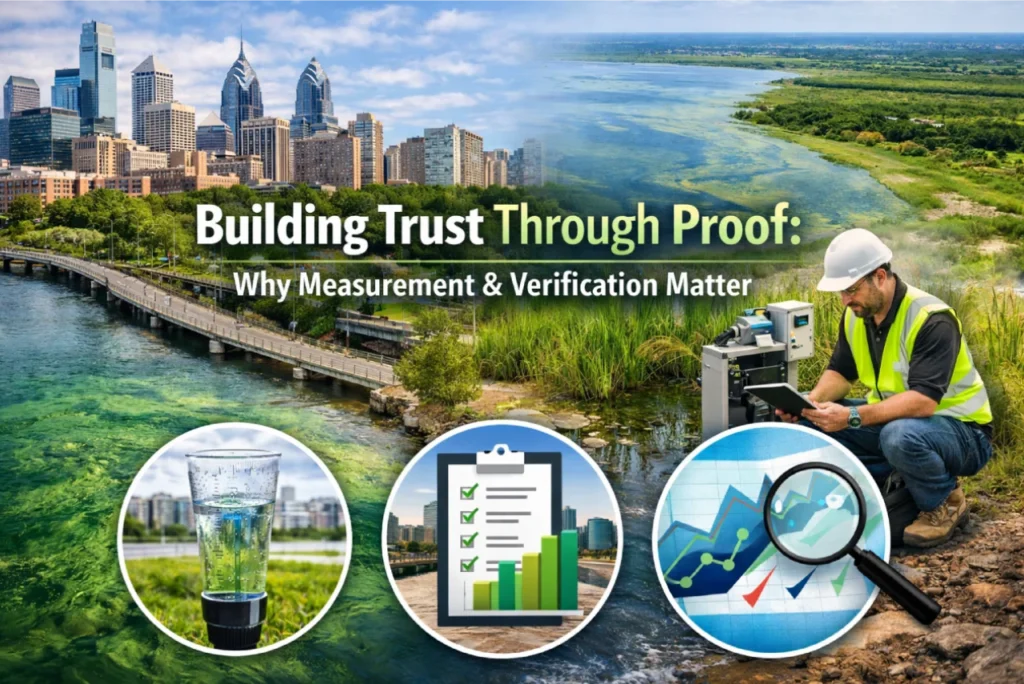
Part 4 of Davis Allen’s series on the evolving stormwater economy makes a clear case. When stormwater outcomes carry financial value, trust must be built on proof, not assumptions.
Why Measurement Matters
In traditional practice, stormwater systems were designed to meet regulatory requirements, installed, inspected, and largely assumed to perform as intended. That model is no longer sufficient.
Today, stormwater credits, fee offsets, and capital planning decisions depend on outcomes that may need to be sustained for decades. Cities must defend compliance long after permits are issued. Investors must trust that environmental performance translates into financial value. Developers must manage risk tied directly to system reliability.
In this environment, one-time design estimates are not enough. Long-term measurement, documentation, and verification are becoming baseline expectations.
Utilities: The Demand for Continuous Proof
Cities like Philadelphia illustrate the scale of the shift. Under its Green City, Clean Waters program, the city committed to capturing 85 percent of combined sewage volume over a 25-year monitoring horizon. Compliance depends not on design intent alone, but on sustained, demonstrable outcomes.
As systems scale and aggregate across multiple sites, utilities require performance data that is:
- Continuous
- Comparable
- Defensible
- Manageable
Yet much of today’s stormwater performance data still relies on modeling assumptions or limited snapshots. Long-term field verification remains rare.
As stormwater becomes financially tied to compliance and infrastructure planning, this gap between estimated and verified performance becomes increasingly significant.
Regulators: A Shift Toward Proof of Performance
Florida’s updated stormwater rules under Rule SB 7040, effective June 2024, reflect a regulatory shift toward long-term proof rather than prescriptive design standards.
Driven in part by recurring algal blooms and nutrient pollution, the rule requires newly installed systems to demonstrate treatment performance over time. Detailed operation and maintenance plans and financial assurance must be in place before permits are issued, and reporting continues after installation.
The message is clear. Presumed performance at the design stage is no longer enough. Outcomes must be demonstrated and documented.
Investors and Developers: Managing Risk Through Verification
In Washington D.C., over 1.7 million stormwater retention credits have been traded since 2014. However, performance is still largely derived from design estimates rather than verified long-term field data.
As credits mature into investment-grade assets, the difference between estimated and verified performance represents both risk and opportunity.
For investors and developers, long-term, defensible measurement reduces uncertainty. Without it, stormwater outcomes become difficult to value, aggregate, or finance at scale.
Engineers and Third-Party Verifiers: Gatekeepers of Trust
As stormwater outcomes transition from design presumptions to financial instruments, the role of engineers evolves.
They are no longer only validating plans. They are validating performance.
Independent verification, repeatable methods, and transparent documentation are becoming essential to support regulatory compliance, municipal planning, and capital allocation decisions. When outcomes persist over decades, professional judgment must be supported by durable data systems.
MRV: The Emerging Standard
Across utilities, regulators, investors, and practitioners, a shared expectation is forming around Measurement, Reporting, and Verification, often referred to as MRV.
- Measurement provides visibility.
- Reporting creates continuity.
- Verification establishes defensibility.
This framework is common in other environmental markets, such as carbon accounting. Stormwater is now moving in the same direction.
If trust depends on verified performance, then stormwater must be measured accordingly.
Why This Matters for the Future of Infiltration
As stormwater performance becomes monetized and integrated into compliance, capital planning, and environmental credit markets, systems that can demonstrate measurable, sustained outcomes will stand apart.
Long-term infiltration performance, aquifer recharge, and runoff reduction are no longer conceptual benefits. They are becoming quantifiable assets.
The ability to measure and verify performance over time will increasingly determine where capital flows and how risk is priced.
Source: Davis Allen, “Building Trust through Proof — Why Measurement and Verification Matter More Than Ever,” Part 4 of the Stormwater Asset Series, available at https://davisallenllc.com/insights
To read the full article and explore the complete series, visit the Davis Allen Insights page.
If you are evaluating stormwater systems through the lens of long-term measurable performance, contact Parjana Engineering to discuss how infiltration-based strategies can support defensible, outcome-driven results.