
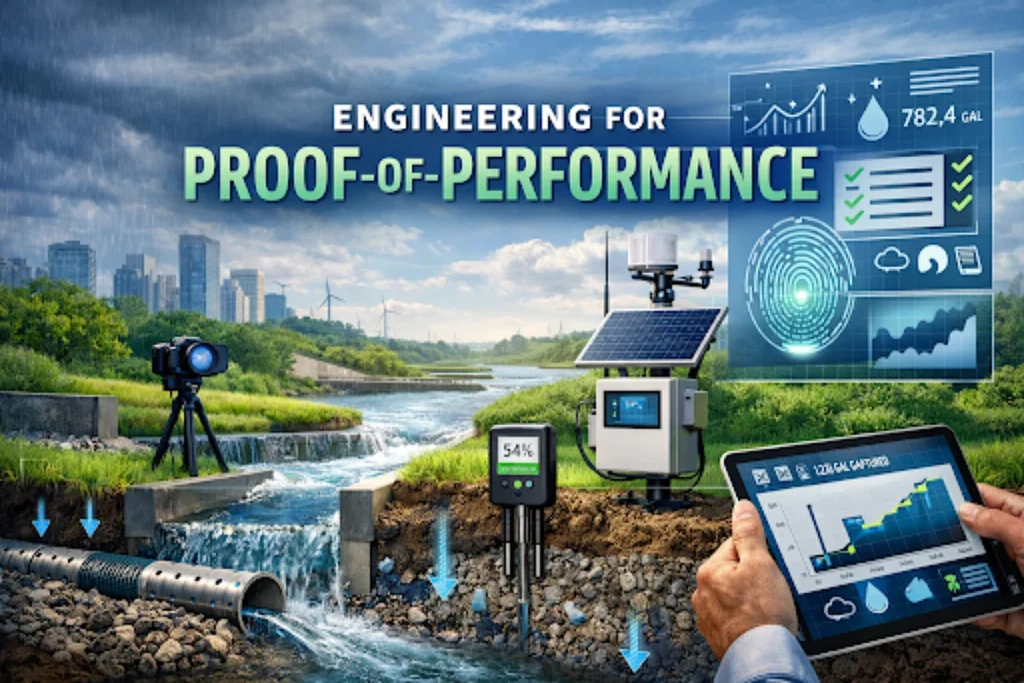
Stormwater management is shifting from a compliance-based model to an outcome-based system where performance must be proven, not assumed. As runoff reduction begins to carry financial, regulatory, and contractual value, engineered systems are expected to generate measurable, verifiable results over time. In this new environment, proof becomes the asset.
Traditionally, stormwater systems were evaluated based on design intent and modeled assumptions. If a system met permit requirements and functioned as designed, it was considered successful. Today, that is no longer sufficient. Markets increasingly rely on documented outcomes rather than projections. Each gallon of runoff reduction must be counted, timestamped, attributed, and tracked. Performance must be recorded and preserved.
This evolution demands a different approach to engineering. Systems must now be designed not only for hydraulic function, but also for measurability, traceability, persistence, and auditability. Sensors, time-lapse imaging, and automated monitoring tools are becoming integral components of infrastructure. Data is centralized and validated through digital platforms, often supported by AI-assisted analysis to ensure consistency across sites, soil types, climates, and operating conditions.
The article highlights a growing divide in environmental markets. Systems that can produce durable, transparent records of performance will earn trust and carry financial value. Systems that function well but lack proof mechanisms risk being sidelined. Without verifiable documentation, regulators assume additional liability, owners face compliance uncertainty, and markets struggle to allocate value accurately. As demonstrated in other environmental markets, such as voluntary carbon programs, unverified claims can create significant financial and reputational consequences.
Proof-of-performance systems redistribute risk. When underperformance is documented early, it can be corrected. When performance is continuously verified, oversight becomes more efficient and confidence increases. In outcome-based frameworks, transparency reduces uncertainty. Trust follows records.
As these systems scale from individual sites to portfolios, the importance of consistent validation intensifies. What works at one location must hold up across dozens or hundreds of installations. The next phase of the stormwater economy will test whether proof mechanisms can scale without losing credibility.
For stormwater professionals, this shift represents both a challenge and an opportunity. Infrastructure that integrates performance verification from the start will be positioned to compete in a market where evidence matters more than intent.
Read the full article, “Engineering for Proof-of-Performance,” at Davis Allen LLC Insights to explore the full discussion and what it means for the future of outcome-based stormwater systems. https://davisallenllc.com/insights